Home / Our Schools / Osaka
Osaka · HonmachiSGG Language School Osaka
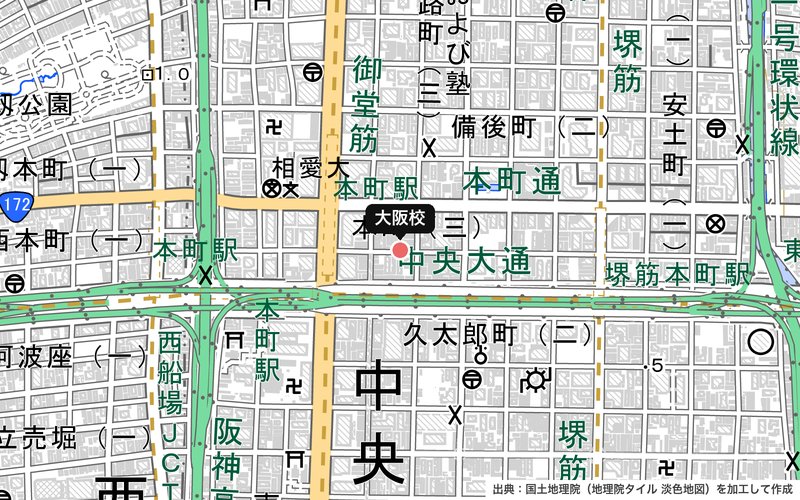
Our base in the Kansai region. The school is in Honmachi, central Osaka, about 2 minutes' walk from Honmachi Station on the Osaka Metro Midosuji Line.
Updated:

Home / Our Schools / Osaka
Osaka · HonmachiOur base in the Kansai region. The school is in Honmachi, central Osaka, about 2 minutes' walk from Honmachi Station on the Osaka Metro Midosuji Line.
Updated:
SummarySGG Language School Osaka is our base school in the Kansai region, located in Minami-honmachi, Chuo-ku, Osaka. It is about 2 minutes' walk from Honmachi Station (Osaka Metro), with intakes in January, April, July and October. In April 2026 it was renamed from Narita Gaigo Gakuin and moved to its current location.
| Address | Daiichi Juken Midosuji Honmachi Building (第一住建御堂筋本町ビル) 3F/5F, 3-4-7 Minami-honmachi, Chuo-ku, Osaka 541-0054 |
|---|---|
| Access | About 2 minutes' walk from Honmachi Station (Osaka Metro Midosuji Line) / about 4 minutes' walk from Sakaisuji-Hommachi Station (Osaka Metro Chuo Line) |
| Intakes | January, April, July and October |
| Capacity | 335 students (capacity increase under application; 225 as of November 2026) |
| Apply | Apply online (fill out the interview application form; upload documents on your personal page after you pass) |
| School hours | 8:30–17:30 |
| Class hours | Morning 9:10–12:30 / Afternoon 13:10–16:30 |
| Closed | Saturdays, Sundays, national holidays, and other days set by the school |
| Breaks (fiscal 2026) | Breaks between terms: June 25–July 7, 2026; September 29–October 5; December 21–January 5, 2027; March 25, 2027–April (dates to be decided) Summer break: August 10–16, 2026 |
| Course length | April intake: 2 years / July intake: 1 year and 9 months / October intake: 1 year and 6 months / January intake: 1 year and 3 months |
| Courses | University preparation course, short-term course (3 months) |
| Students' home countries | China about 60%, Southeast Asia about 30%, Europe and the Americas about 10% |
| History | April 2023: Tsukuba Gaigo Gakuin in Tsuchiura, Ibaraki, moved to Misatodai, Narita, Chiba, and became Narita Gaigo Gakuin April 2026: Narita Gaigo Gakuin was renamed SGG Language School Osaka and moved to its current location |
| Principal | Ryota Nakazawa |
| Contact | Phone +81-6-6926-8708 · info.osaka@sgg-school.com |


| University (campus) | Travel time |
|---|---|
| Osaka Metropolitan University (Nakamozu Campus) | About 29 minutes by train |
| Kansai University (Senriyama Campus) | About 32–35 minutes by train |
| Kindai University (Higashi-Osaka Campus) | About 32–35 minutes by train |
| Osaka University (Toyonaka Campus) | About 38–40 minutes by train |
| Kwansei Gakuin University (Nishinomiya-Uegahara Campus) | About 44–50 minutes by train |
Within a 1–4 minute walk there are several FamilyMart stores, two 7-Eleven stores and two Lawson stores.
If you would like to study here, please apply online. Fill out the interview application form; after you pass, enter your COE information and upload documents on your personal page.
| April intake | July intake | October intake | January intake | |
|---|---|---|---|---|
| Application deadline | End of October | End of January | Mid-April | End of July |
| Certificate of Eligibility (COE) issued | Late February | Late May | Late August | Early November |
| Deadline for tuition and residence fees | Around March 10 | Around June 10 | Around September 10 | Around November 20 |
| Case | Condition | Refund |
|---|---|---|
| The COE was issued, but you did not apply for a visa and did not come to Japan | Return the letter of admission and the COE | Full amount except the admission fee |
| You applied for a visa at a Japanese embassy or consulate, but it was refused and you could not come to Japan | Return the letter of admission and submit proof that the visa was not issued | Full amount except the admission fee |
| You obtained a visa but withdrew before coming to Japan | Return the letter of admission; the school must be able to confirm that the visa expired unused | Full amount except the admission fee |
| After arriving and enrolling, you left the school without a valid reason | — | As a rule, no refund |
You submit documents about yourself and documents about your financial support. Required documents may differ by nationality.
1. Application form (handwritten by the applicant on the school's form)
2. Personal history (handwritten by the applicant on the school's form)
3. Certificate of graduation (or certificate of expected graduation) from your most recent school, or the original diploma (applicants from China, Bangladesh, Mongolia and Myanmar: the original diploma)
4. Academic transcript from your most recent school (original)
5. If you are currently a student: certificate of enrollment and academic transcript (originals)
6. Proof of Japanese language study (an original issued by a Japanese language school, or a copy of a Japanese proficiency test certificate)
7. Copy of your passport (if you have one)
8. 10 photos (4 cm tall × 3 cm wide; digital photos printed at home are not accepted)
9. Other documents the school requires
Applicants from China need a score report for the national college entrance exam (gaokao) or the high school graduation exam (huikao), verified by the China Academic Degrees and Graduate Education Development Center (CDGDC) of the Ministry of Education. If you graduated from a vocational high school or secondary specialized school and did not take the gaokao, you need a copy of a JLPT Level 3 certificate or a J.TEST Level E certificate.
1. Bank balance certificate in your name (original)
2. Certificate of employment (original)
3. Certificate of income (past 3 years, original)
4. Documents showing how your savings were built up (copies of bankbooks, etc.)
1. Letter of financial support (original)
2. Sponsor's bank balance certificate (original)
3. Copy of fixed-deposit certificates (China only)
4. Sponsor's certificate of employment (original, showing years of service)
5. Sponsor's certificate of income (original, showing annual income for the past 3 years)
6. Tax payment certificate (original, showing the amount of income; required for China and other nationalities specified by the school, past 3 years)
7. Proof of the relationship between the applicant and the sponsor (notarized certificate of family relationship, birth certificate, etc.)
8. Documents showing how the savings were built up (copies of bankbooks, etc.)
9. Copy of the household register (hukou) (China only, all household members)
10. Copies of the original and duplicate business license of the sponsor's employer
11. Other documents the school requires
1. Letter of financial support (original)
2. Sponsor's bank balance certificate (original)
3. Sponsor's certificate of employment (showing years of service; self-employed: copy of the final tax return; business owners: certificate of corporate registration)
4. Sponsor's income certificate (issued by the city or ward office, showing annual income for the past 3 years)
5. Certificate of residence (juminhyo) (all household members)
6. Proof of the relationship between the applicant and the sponsor (family register (koseki tohon), notarized certificate of family relationship, etc.)
7. Documents showing how the savings were built up (copies of bankbooks, etc.)
8. Seal registration certificate (original)
9. Other documents the school requires
The applicant and the sponsor must fill out the application documents by hand and leave nothing blank. Corrections and correction fluid are not allowed. If you make a mistake, start again on a new form. Attach a Japanese translation to every document that is not in Japanese. We may ask you to submit other documents if needed.
See only the documents you need, by nationality and who pays, with our Certificate of Eligibility (COE) guide. For fees, see Fees & Scholarships. The admission guidelines for each intake are the official source for courses, fees and admissions.
Documents for all our schools are collected on the public disclosure page (Japanese).
SGG Language School Osaka issues certificates of graduation and other documents for graduates of the former Narita Gaigo Gakuin. Please use the contact page or contact the Osaka school directly (phone +81-6-6926-8708 · info.osaka@sgg-school.com).

Principal, Osaka
Ryota Nakazawa
When I was young, I studied in Shanghai for six months, and later I lived in China for five years for work. If Tokyo is a city that values rules and self-discipline, Osaka is a city that values the daily lives of the people who live there. Daily life here is more compact than in Tokyo, and it is easy to get anywhere. A short trip takes you to Kyoto, Nara, Kobe or Wakayama in about 45 minutes to 2 hours. Between Umeda Station and the school is Nakanoshima Park, where museums and libraries stand among the office buildings.
For some people, studying at a Japanese language school is a goal in itself. For others, it is the foundation for trying to enter a school in Japan. Students of different nationalities, backgrounds and goals come together around one thing: learning Japanese. The SGG group has always valued "creating chances for learners to speak Japanese themselves, and supporting their growth." We want to be a school that grows together with the students who choose us because they share this idea.
Our head of academic affairs is Tadashi Miyagawa (宮川正), and our office manager is Xinyi Ma (馬心怡). Xinyi Ma also once came to Japan as an international student. Students come to the office with all kinds of questions: renewing their residence card or visa, entrance exams for further study, and even a lost mobile phone, how to open a bank account, or how to move to a new apartment.
Daiichi Juken Midosuji Honmachi Building 3F/5F, 3-4-7 Minami-honmachi, Chuo-ku, Osaka. It is about 2 minutes' walk from Honmachi Station on the Osaka Metro Midosuji Line, and about 4 minutes' walk from Sakaisuji-Hommachi Station on the Osaka Metro Chuo Line.
In April 2026, Narita Gaigo Gakuin was renamed SGG Language School Osaka and moved to its current location (Minami-honmachi, Chuo-ku, Osaka). SGG Language School Osaka issues certificates for graduates of Narita Gaigo Gakuin.
Students come from China (about 60%), Southeast Asia (about 30%), and Europe and the Americas (about 10%). The school offers a university preparation course and a 3-month short-term course.